




Non-coding RNAs in response to therapies in lung cancer
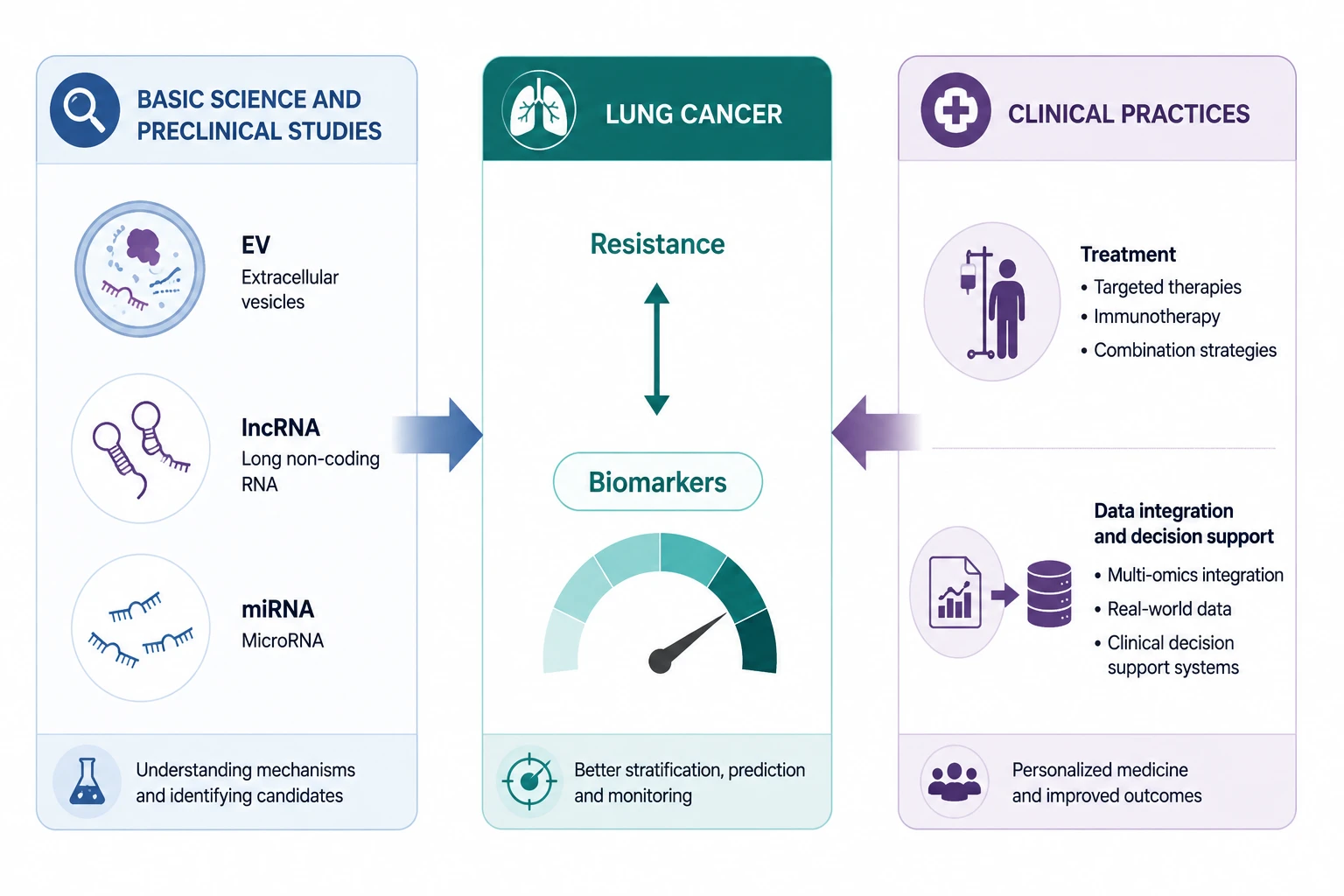
While previous studies highlighted specific microRNAs (miRNAs) involved in radioresistance (RR) (Labbé, Mol Cancer, 2020), the underlying mechanisms remain unknown. We performed small next-generation sequencing (NGS) and identified miR-200c-3p as the most strongly downregulated miRNA in RR cancer cells. Interestingly, its exogenous overexpression restored radiosensitivity of RR cells by delaying DNA repair through a direct targeting of HP1α, a protein involved in DNA repair (Labbé, Cell Death Dis, 2024). We further demonstrated that miR-200c-3p can be detected outside of tumor cells in their small extracellular vesicles (EVs), which supports that miR-200c-3p could be a valuable noninvasive biomarker. Although non-coding RNAs (ncRNAs) are frequently found in EVs, the mechanisms controlling their loading and sorting into these vesicles remain poorly understood. We found that TP53 mutations in cancer cells were associated with a distinct miRNA and long ncRNA (lncRNA) cargo in small EVs. The EV-enriched ncRNAs exhibited a shared sequence motif, highly similar to the RNA-binding motif of SAM68, a protein interacting with hnRNP proteins. Interestingly, SAM68 protein was highly expressed in TP53 mutant cell lines, explaining the different expression profile and loading of ncRNAs into their small EVs (Labbé, JEB, 2023). Overall, these findings highlight that ncRNAs, beyond their functional role in resistance, are valuable circulating biomarkers (Chang, Mol Cancer, 2026).
We are currently pursuing two research projects:
-
Characterizing miRNA-containing extracellular vesicles (EVs) and their role in the immune response in non-small cell lung cancer (NSCLC).
-
Investigating the contribution of long non-coding RNAs (lncRNAs) to resistance mechanisms against targeted therapies in NSCLC.
Group members
Elvire Pons-Tostivint, MCU-PH
Virginie Dehame, AI
Saiveth Hernandez-Hernandez, Post-doc
Manon Chang, PhD student
Thomas Papazyan, PhD student
Maëliss Laurioux, Master 2 student
Other team members involved
Marc Denis, PU-PH
Chloé Sauzay, MCU-PH
Manon Robert, PhD student
Main collaborations
Rémy Pedeux, OSS, Rennes
Thomas Derrien, IGDR, Rennes
Pierre-François Cartron, Team 7 CRCI2NA
Etienne Giroux-Leprieur, Hopital Ambroise Paré
Selected Publications
Loss of miR-200c-3p promotes resistance to radiation therapy via the DNA repair pathway in prostate cancer. Labbé M, Chang M, Saintpierre B, Letourneur F, de Beaurepaire L, Véziers J, Deshayes S, Cotinat M, Fonteneau JF, Blanquart C, Potiron V, Supiot S, Fradin D. Cell Death Dis. 2024 Oct 16;15(10):751. doi: 10.1038/s41419-024-07133-3.
TP53 mutations correlate with the non-coding RNA content of small extracellular vesicles in melanoma. Labbé M, Menoret E, Letourneur F, Saint-Pierre B, de Beaurepaire L, Veziers J, Dreno B, Denis MG, Blanquart C, Boisgerault N, Fonteneau JF, Fradin D. J Extracell Biol. 2023 Jul 31;2(8):e105. doi: 10.1002/jex2.105. eCollection 2023 Aug.
microRNAs identified in prostate cancer: Correlative studies on response to ionizing radiation. Labbé M, Hoey C, Ray J, Potiron V, Supiot S, Liu SK, Fradin D. Molecular Cancer 2020 Mar 23;19(1):63. doi: 10.1186/s12943-020-01186-6. Review.
MicroRNAs in Tumor Exosomes Drive Immune Escape in Melanoma. Vignard V, Labbé M, Marec N, André-Grégoire G, Jouand N, Fonteneau JF, Labarrière N, Fradin D. Cancer Immunol Res. 2020 Feb;8(2):255-267. doi: 10.1158/2326-6066.CIR-19-0522.
Alumni
Master students: Léo Lucas (2026), Luc Condamine (2025), Ivan Anguillet (2024), Manon Chang (2022), Lyna Kara-Terki (2020), Maureen Labbé (2019, 2018), Estelle Menoret (2019, 2018), Alice Molle (2017)
Undergraduate students: Emilie Catteau (2026), Loane Lechat (2026), Orlanne Aumond (2025), Théo Bodet (2023), Loïc Savarit (2018)