



Paediatric cancers: from care to research. Interview of Professor Isabelle Pellier and Mélanie Hippocrate
To mark Gold September, Paediatric Cancer Awareness Month, Professor Isabelle Pellier, Head of the Paediatric Specialities Department at Angers University Hospital and member of the INSERM research team at CRCI2NA, and Mélanie Hippocrate, Project Officer in the same department, discuss these tumours in children, adolescents and young adults, as well as the link with research and patient organisations.
Interview of Professor Isabelle Pellier and Mélanie Hippocrate
Could you introduce yourself? What led you to the Paediatric Haematology-Oncology Unit at CHU Angers?
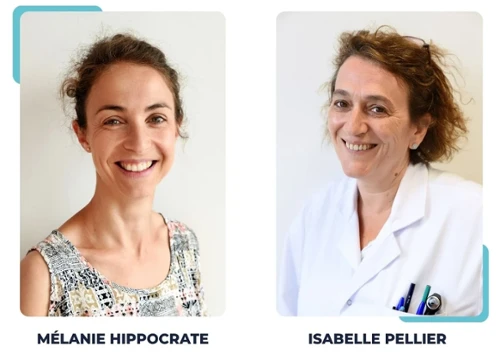
Pr. I. Pellier
I am a paediatrician specialised in paediatric haematology and oncology at Angers University Hospital, and a clinician-researcher within the ‘Innate Immunity and Cancer’ team at CRCI2NA. My work crosses the fields of care, research and teaching, with a very specific aim: to better understand childhood cancers in order to improve their diagnosis, treatment and management.
What led me to paediatric oncology was the people I met – doctors, children and their families. I was particularly interested by the opportunity to support these families over the long term, whilst working within multidisciplinary teams and in close collaboration with the research community.
M. Hippocrate
As a Project Officer, I have been working in this unit for over six years. This section, headed by Professor Isabelle Pellier, welcomes children and young people from 0 to 18 years with cancer.
Looking back on my career, after completing a Master’s degree in the management of health and medico-social organisations, I worked as a project manager at the Angers Municipal Social Action Centre. This experience confirmed my interest in project management.
Today, my work involves developing, in collaboration with parents’ associations, projects to improve the daily lives of hospitalised children, their families and healthcare staff. We have, in particular, introduced animal-assisted therapy and hypno-analgesia kits to reduce anxiety. I identify the needs of the teams and ensure their support of the projects. I therefore work closely with healthcare staff, organisations and partners.
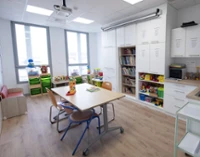
Aujourd'hui, mon travail consiste à développer, avec les associations de parents, des projets visant à améliorer le quotidien des enfants hospitalisés, de leurs familles et des soignants. Nous avons notamment mis en place la médiation animale et des mallettes d’hypno-analgésie pour mieux soulager l’anxiété et la douleur lors des soins. J’identifie les besoins des équipes et veille à leur adhésion aux projets. Je travaille ainsi en lien étroit avec les soignants, les associations et les partenaires.
Why is dialogue between research and the hospital essential?
Pr. I. Pellier
At the hospital, the doctors in the unit focus on the diagnosis, treatment and care of children with cancer, malignant or non-malignant haematological disorders, or primary immunodeficiencies.
At CRCI2NA, we seek to understand the mechanisms underlying these diseases and to identify new biomarkers or new therapeutic targets. These two activities are linked: the issues encountered with patients provide information for research, and the findings of that research must, ultimately, be returned to the patients.
What does Gold September mean for you?
M. Hippocrate
Gold September is, above all, a key period for raising awareness of cancers affecting children, adolescents and young adults, which remain rare but particularly heavy conditions for patients and their families. Every year, nearly 3,000 young people are diagnosed in France and, although around 83 % recover, these cancers remain a major cause of death from disease among children. In Angers, as the reference unit for the Greater West region, our unit supports nearly 80 new patients each year, including all those affected by a brain tumour.
This month is therefore an opportunity to raise awareness, mobilise and remind people that, behind the numbers, there are children, families and teams fighting every day.
Pr. I. Pellier
Gold September is a time dedicated to raising awareness, solidarity and commitment. It allows to raise awareness of childhood cancers, support families, highlight the work of healthcare professionals and researchers, and to remind that progress requires collective and sustained mobilization. It is also a message to children and families: you are not alone.
For our teams, seeing the support from individuals and associations gives strength and reinforces the meaning of our work. It reminds us that the fight against paediatric cancers extends far beyond the walls of the hospital and the laboratory.
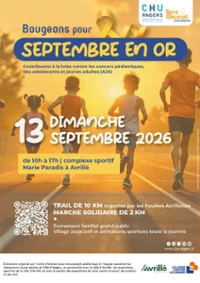 You are organising ‘Let’s move for Gold September’
M. Hippocrate
On Sunday 13 September, our unit and the Adolescents and Young Adults mobile team, are organising the ‘Let’s Move for a ‘Gold September’ event at the Marie Paradis complex in Avrillé (49). Adapted physical activity (APA) is now recognised as a supportive treatment, helping to improve the physical fitness, psychological wellbeing and self-confidence of children and teenagers during and after treatment.
Alongside many local and associative partners, the event will offer several highlights, open to all: a run, a walk, climbing, the ‘spORtifs’ challenge – a multi-activity team course… There will also be a village bringing together around ten associations involved in the fight against paediatric cancers, and activities. The funds raised, particularly during the charity walk, the trail run and the raffle, will help to improve the quality of care and support research into the development of new treatments.
*Information and registraion
As a project manager, you are often in contact with associations.
M. Hippocrate
Associations are essential to the unit and work alongside us. They support both research through donations and fundraising, and the unit by helping to finance equipment to improve the environment for children and parents and to support families. A relationship of trust exists between us.
Pour conclure, quelle est votre motivation au quotidien ?
Pr. I. Pellier It is the therapeutic advances and improvements in care pathways made in recent years for children and their families, but also the conviction that every unresolved issue can become the starting point for progress.
Every child is unique and must be considered in terms of their individuality and environment, with treatments that are, fortunately, becoming more and more precise and targeted to the underlying disease.
M. Hippocrate
The notion of usefulness is essential for me, and I find it fully reflected in my work within the unit. I enjoy working in close contact with the teams, associations and the different services of the hospital. Working collectively on projects is also very important to me. It is ultimately this diversity of tasks, people I work with and projects that fuels my motivation every day.
