

Gold September: a collective effort - Interview with Benjamin Ory
https://crci2na.univ-nantes.fr/medias/photo/photo-b-ory-ligue-contre-le-cancer-2026_1790670381730
Gold September raises public awareness of cancers affecting children, adolescents and young adults. In France, nearly 2,500 young people are diagnosed with cancer every year. Within CRCI²NA, the CHILD team focuses its research on paediatric cancers, particularly paediatric sarcomas. Interview with the team leader, Benjamin Ory.
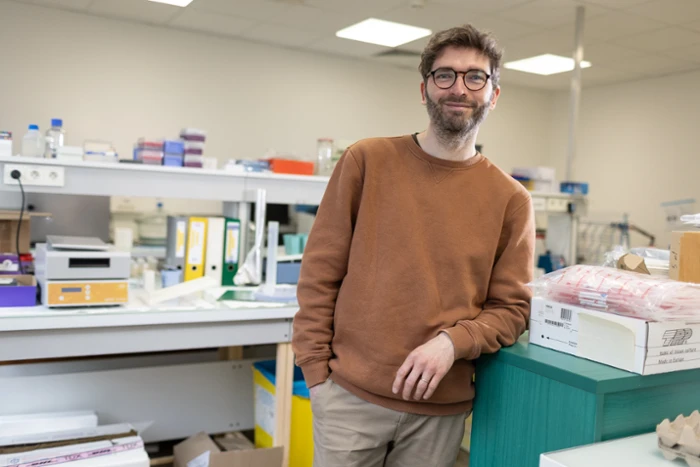
Could you introduce yourself?
I am a teacher-researcher at the Faculty of Medicine in Nantes and I lead the CHILD* research team at CRCI²NA. For the past 20 years, our team devoted its research to paediatric cancers.
*CHromatIn and transcriptionaL Deregulation in pediatric bone sarcoma
What is your team’s research focused on?
We are mainly interested in osteosarcoma, the most common primary malignant bone tumour in adolescents and young adults. This tumour arises directly within the bone. It is a rare disease: in France, there are around 400 new cases of paediatric bone tumours each year.Today, when osteosarcoma is diagnosed at an early stage, the five-year survival rate is around 70 per cent. However, when metastases are already present at the time of diagnosis, this rate drops significantly.
Within our team, we study the influence of the tumour microenvironment on tumour development and progression – in other words, what happens around the cancer cells that may influence their behaviour. We are also interested in epigenetics. The aim is to understand which genes the cancer uses to resist treatment and why these genes are activated when they should be deactivated – or the opposite – without altering the DNA itself. Understanding why some tumours become resistant is essential for ultimately improving the treatments offered to patients.
What are the main challenges in pediatric cancer research today?
The first challenge is the limited number of available samples, which requires collaboration through networks at both national and international levels.The second is to develop more effective treatments whilst reducing their side effects, which are particularly significant in children whose bodies are still developing.
You work with Nantes University Hospital.
Our team is affiliated with the paediatric oncology department at Nantes University Hospital.Discussions with clinicians help to identify new research questions arising from patient care and the challenges encountered.
The research also relies on several collaborations. Who are your main partners?
Research is a true team work. Within the laboratory, biologists, pharmacists, engineers, technicians and academic researchers combine their expertise. Each has their own specialty in terms of pathology and approach, all relating to paediatric cancers.The team also works with national partners – the CRCL in Lyon and teams in Marseille and Toulouse – as well as with several European partners as part of the FOSTER network, dedicated to research into osteosarcoma.
These collaborations bring together complementary skills: molecular analysis, pharmacology, preclinical modelling, and so on.
For example, we analyse sequencing within our team. Once the genes involved in resistance are identified, we work with chemists in Boston to test molecules and evaluate their pharmacological potential. Ultimately, our aim is to make existing treatments more effective, in particular by repurposing molecules that are already known and used to treat other diseases.
 Associations play an important role in research.
Associations provide important support for us. Their financial support is essential for our team to continue our research. They also create a link between researchers, families and patients, and raise public awareness of these rare diseases.The Ligue contre le Cancer 44 also plays a major role in funding research into paediatric cancers. Our team currently benefits from a major collaborative project dedicated to cancers affecting children and adolescents. Without this kind of support, many projects could simply not get off the ground. Thank you to the Ligue and to the associations for their support.
The laboratory also opens its doors to organisations, families and, sometimes, young patients. These visits give meaning to our commitment. They remind us that behind every research project there are children, teenagers and families waiting for solutions.
What does Gold September mean to you? What message would you like to share?
Gold September helps raise awareness of paediatric cancers and reminds us that research needs support. The more people know about these diseases, the more attention they attract from public authorities, funding bodies and charities. Every effort counts.In recent years, this collective effort has led to the creation of new funding programmes specifically dedicated to paediatric cancers. This proves that raising awareness can make a difference.
Research progresses thanks to collective effort. Every support, every donation, every solidarity event contributes to advancing our understanding and, in the long term, to offering new solutions for children and teenagers affected by these diseases.
Researchers, healthcare professionals, patients, families, associations, volunteers, donors and institutions all contribute together to making progress in the fight against these diseases.
Further information
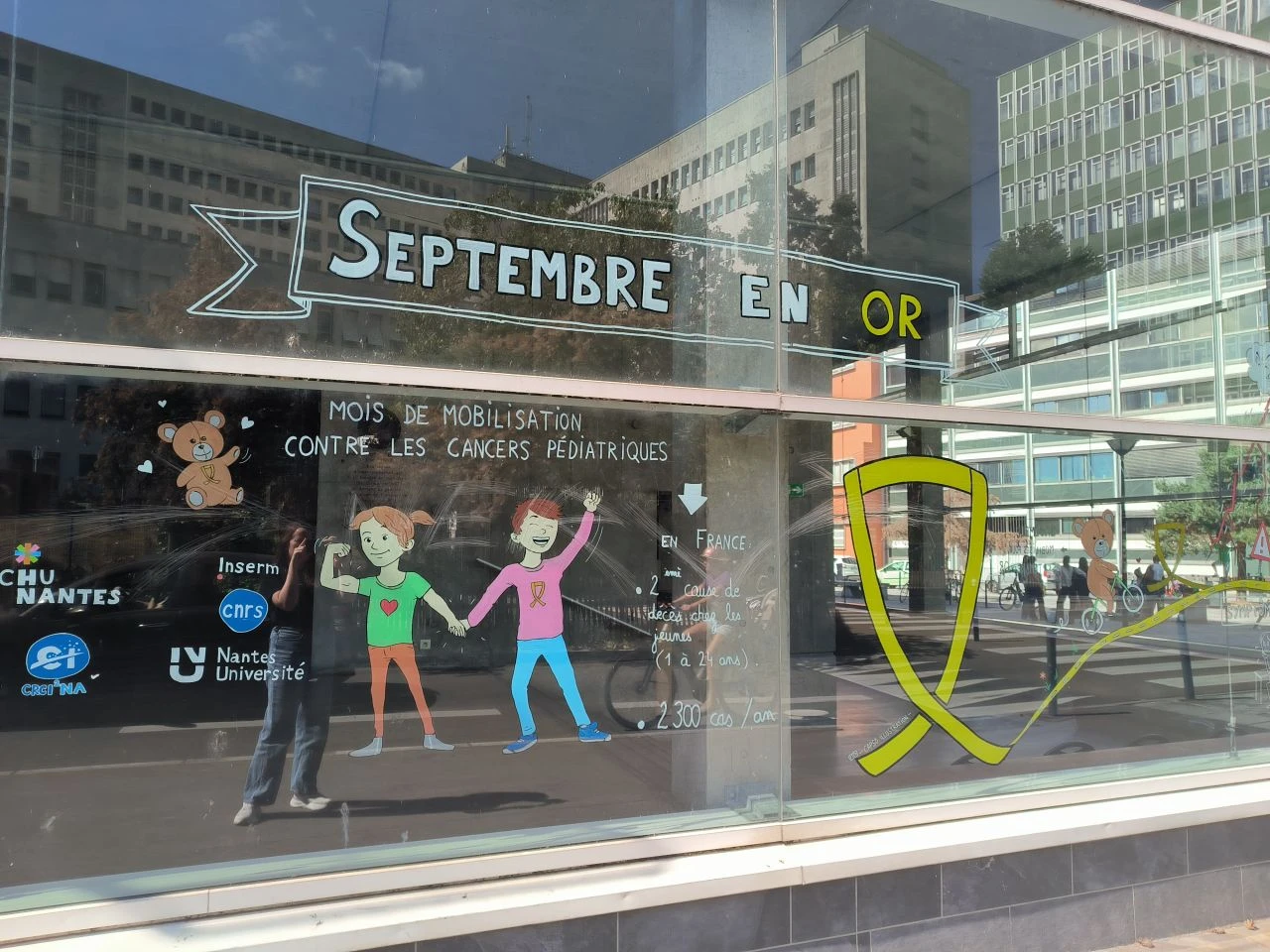
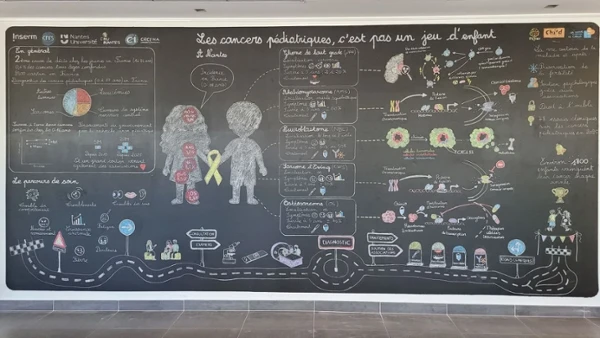 As part of Gold September, several members of the CHILD team and the PETRY team took part in the creation of a mural on the windows of the Kernéis amphitheatre at Nantes University, in collaboration with Capso Illustration, and an accessible illustration at the IRS-UN in Nantes to raise awareness of paediatric cancers and promote a better understanding of patients’ care pathways. A CRCI2NA seminar on this topic was also organised by the team for Gold September.
- Further information is available at: https://crci2na.univ-nantes.fr/en/research/team-9" class="type_rubrique_0001
- You can also watch the video ‘Inside the CHILD laboratory’ at: https://www.youtube.com/watch?si=ZtS8ZFgo9hJjMgJi&v=wKA6zK7m0zg&feature=youtu.be

Updated on 14 October 2026.